Avocados are one of those amazingly healthy foods that even kids will eat and they seem to be nice and ripe in stores right now. Usually they are from Mexico but still on our continent at least. They have nearly 20 different vitamins and minerals, they are a source of healthy fats, and they are creamy so they can be fed to babies and toddlers as well.
Some ways to serve Avocados:
* For guacamole and chips of course!
* As dip for veggies
* Blend them up with cacao to make chocolate pudding
* As filling for raw key lime pie
* Slip some slices into sandwiches
* Puree and add to hot cereal
* Combine with tuna for a sandwich filler
* Spread on toast or a bagel
* Add strips or chunks to salads
You can tell when they are ripe by their dark green, pebbly skin and they will stay good in a fridge for 3-5 days. If you only need to use half of the avocado just squeeze some lemon juice on the remaining half to keep it from going brown. You can also use an avocado saver.
To make the job of scooping out the filling and slicing easier I recommend an avocado slicer. I find mine to be a bit hard to clean but if you have a dishwasher (I don’t) that may not be such a big deal. Enjoy!


This week I came across two different articles – one in my local newspaper and the other in magazine – that focus on the problems that are facing our bees. Hives are dying off and the bees are disappearing and this has many people VERY concerned. Why? Well, ecosystems in general are a complex series of interconnected life forms that depend upon each other. It very much is a circle of life and when part of the circle breaks… this means trouble for all other parts of it. Ecosystems exist in a state of balance and when one component is affected, the whole system is thrown off.
Bees are an integral part of a healthy ecosystem. They aren’t just helpful to have around… we NEED bees! No bees means no pollination, which means the disappearance of certain plant species, which in turn means the disappearance of certain animal species. I read somewhere that a 1/3 of US crops are pollinated by bees so even mighty humans will be heavily impacted if bees disappear.
Here are some things to think about the next time you get annoyed by a bee.
1. Pollination
Bees’ pollination efforts are responsible for a wide diversity of wild flowers and many crops depend on them. In fact, without bees’ pollination of flowering crops and flowers, there would be far less food in general and diversity in particular. In fact, if bees did not pollinate in the wild, some vegetation would become extinct, leaving space for invasive, problematic species to take over. Animals that eat the extinct vegetation would then die off, followed by the carnivorous animals that eat the herbivores. As noted above, it’s all connected. You cannot take one link out of the chain and expect it to function.
Human food is dependent on bees too. Apples, pears, cucumbers, cherries and other flowering/fruiting crops depend on bees to fertilize the flowers so that fruit will develop. When a bee gets nectar from a flower, it gets coated in pollen. The bee then carries this pollen to another flower, fertilizing it and causing the flower to develop into a fruit. Without pollination, many flowering crops would not yield fruit, or would yield very little.
2. Bee products
Human health is greatly enhanced by the inclusion of bee products. Here are some important items that bees provide that can benefit humans.
* Honey – Honey is not just another sweetener. Raw, unfiltered honey that has had minimal processing from hive to jar has many healthful benefits. It contains all sorts of vitamins, including phosphorous, iron, vitamins A, B-complex, C, D, E and K. According to herbalist Stephen Buhner, honey has at least 75 different compounds.
A spoonful of raw honey makes an excellent cough syrup, and it can serve as a base for home-made medicinal syrups. Raw honey is a remarkable dressing for severe burns, and the antibiotic properties of honey have excelled conventional antibiotics in the treatment of ulcers and surgical infections. Honey has even been touted as an excellent treatment for allergies.
* Beeswax – This natural, beautiful product has been used to make candles, lip balm, cosmetics, crayons, moisturizers, and other items.
Many vegans argue that we should not utilize bee products and to some extent they are right on. I would, however, say that we need to support bee keepers who take care of their hives well and who extract honey sustainably. If there is no support for them, then people will get honey from major agribusiness who will be far less ethical in their handling. Patronizing ethical beekeepers gives them a reason to keep up the good work they do. Without changing the external factors that are harming our bees they will still be in danger of disappearing so we need to keep the good guy on the case.
The bee is an important component of the ecosystem, and we humans, as part of the ecosystem, benefit greatly from what bees do. It would be wise for us to talk to local beekeepers, find out what we can do, patronize those are helping repopulate bee populations, to stop using chemicals in our yards that can harm the bees, and to contact bee removal experts if we feel a hive is too dangerous to remain on our property. We all need to think a little bit more about those little guys and what we can do or stop doing to make sure they stick around.
What do you think? How can we bee more proactive about protecting bees?

Whole Foods Market is running a 3-part podcast series promoting the “Premium Body Care” standard they have created, and the importance of know what is in your Body Care products.
Podcasts:
1. Premium Body Care® – A Worthy Challenge- discusses how their standard helps define What “Natural” really means in body care products.
2. In, Holding the Bar High in Natural Body Care – you’ll hear about why these strict natural guidelines are important. You’ll also learn about Campaign for Safe Cosmetics, a national coalition of health and environmental groups that are working to eliminate harmful chemicals from personal care products.
3. Positive Changes for the Industry, for Everyone – looks at how these standards raise the bar for the natural body care industry as a whole.
You can check these podcasts out here.

For many years I have loved felt foods for pretend play. They make the perfect addition to any play kitchen or pretend picnic. Sure you can get cheap plastic faux foods but it just isn’t the same. Because I knew they would not be very hard to sew myself I often decided to go with wood instead of felt… ya know, why pay for something you can make right? The problem is that I never made any… the time it would take to draft a pattern and test and tweak just seemed like too large an undertaking and most of the patterns I have seen for them have been kind of spendy. Generally you will have the most luck finding these adorable foods or the patterns for DIY versions, from natural toy makers or Etsy artisans.
Recently discovered the VERY affordable Lilly Bean Market Felt Kits at one of my fave online stores for organic toys, Down to Earth Toys. These felt toys are so very cute and so very easy on the pocketbook. The Fruit Felt Kit is only $7.99 for instance, and you get the stuff to make 4 different fruit toys. It comes with the felt, the patterns, and the step by step instructions with lots of pictures. Plus, after you cut out the patterns, you can reuse them again and again with your own felt.

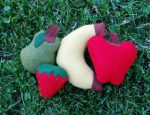
The kit comes with everything you need to make a felt apple, pear, banana, and strawberry. They were all equally involved with the strawberry being perhaps a bit more difficult than the others. All of them were pretty fun to complete.. after some swear words and finally figuring out the trick to turning the pear and apple right side out after stitching. Maybe it has been too long since I had a sewing day but that 3/4 inch opening was kicking my butt. All I needed to supply was was fiberfill, thread, scissors, a needle, and a sewing machine. The sewing machine to hand sewing ratio is about 30/70%. I haven’t done much hand sewing in recent years due to carpel tunnel syndrome, but I managed okay. All the fruit needs to be closed by hand and the leaves, stems, and ends of the banana all require hand stitching. Because you basically cover the stitched openings with other fabric elements, it all comes out very clean and nice looking.

For the hand stitching I chose to use like colored thread but for the machine sewing it was white or nothing.. call me lazy, but I still think they turned out very nice despite this.
And of course the real test.. do kids like them? Of course! They are infinitely better than plastic as far as texture and a real “feel” is concerned. My youngest son hasn’t quite caught on to why fake food is fun (that is his sister’s domain) but even he had to giggle and take a bite of the apple.

I am excited about having these groovy patterns now so that I can make up a basket of felt fruit for gifting the little people in my life and I am excited about our next LillyBean Market kit… oh yeah.. we’re gonna make some pie! Stay tuned for that one!

Just make sure to put away your scissors when you are finished lest some child who will not be named take them to her hair… grrrr!