3
Mar

Now Is the Time to Pick a CSA

csa boxSpring is just around the corner and pretty soon we will start seeing the first of springs harvest. I can almost taste the fresh leafy greens. It is time to start planting seedlings for your garden. Or if you cannot garden or don’t have a desire to it is perhaps time to send in your CSA share money. This will be one of the first years I will not be joining a CSA because I will have my garden and I have one awesome farmer’s market about 2 minutes from my home. But it was hard to come to that decision because I absolutely LOVE the concept of a CSA and being a member of one. :(

What is a CSA? It stands for Community Supported Agriculture.

You may have heard of farm sharing programs or Community Supported Agriculture programs (CSAs) before. They are gaining popularity and getting a lot of media exposure in recent years for their ability to help bring real and local food back to the table every night and support local economies. They are instrumental in helping people to eat their meals from farm to plate.

All those small scale farmers in your area are at a serious disadvantage these days. They simply cannot compete with large agri farm operations that sell to major grocery markets. Small farmers usually have to sell to their neighbors, at roadside stands, and at farmer’s markets. They have had to work hard to find a loyal customer base and unlike large agribusiness operations, small farmers might find themselves out of business the very first time their crops are destroyed or fail to thrive. It is such a sad state of affairs. So….realizing that smaller farms serving the locals might soon be gone with the wind some of them have gotten creative and decided to extend an invitation to their local communities in the form of CSAs.

I am happy to see that many have answered that call.

So how does it work? CSAs work when the farmers sell a portion or a share of their harvest to their neighbors. For a seasonal fee they get a box of fresh farm fruits and veggies every week. I remember being giddy on delivery days each week…just waiting for my box of farm fresh goodies. The CSA that I belonged to in Arizona was run by a gal named Kelly and she included pertinent recipes every week so I was in culinary heaven each week. It was that first year that got me hooked on Kale…because I was swimming in it, LOL. Before that I had never even tried it so being a CSA member also exposes you to new and exciting foods. I did an interview with my local CSA farmer in Arizona at Desert Roots Farm if you want to read about it.

Here was Kelly’s definition of a CSA:

Community Supported Agriculture is a partnership of mutual commitment between a farm and a community of supporters which provides a direct link between the production and consumption of food. Supporters cover a farm’s yearly operating budget by purchasing a share of the season’s harvest. CSA members make a commitment to support the farm throughout the season, and assume the costs, risks and bounty of growing food along with the farmer or grower. Members help pay for seeds, fertilizer, water, equipment maintenance, labor, etc. In return, the farm provides, to the best of its ability, a healthy supply of seasonal fresh produce throughout the growing season. Becoming a member creates a responsible relationship between people and the food they eat, the land on which it is grown and those who grow it.

As Kelly touched on, the farmers have more freedom, security, and flexibility when their costs and products are paid for up front. The consumer benefits by having continuous veggiesaccess to local and healthy foods that don’t have to cause planetary destruction on their way to you. The consumer also absorbs some of the risk involved in farm management because if the crops fail for whatever reason the farmer has already been paid and he or she will not be forced out of business. The consumer, although unhappy to see no food that season, is satisfied in supporting his local community and protecting his or her local food sources.

There are some CSAs that allow you to pay for your farm share or a portion of it in trade for labor. You might be put to work weeding, harvesting, packaging CSA boxes, or delivering the food. This arrangement keeps costs down for both the farmer and the consumer. In my area (Ohio) a whole share from May to October costs about $650 and that pays for a box of farm fresh goodies every week. You can also do a half share for a smaller family. In Arizona it was a bit more expensive.

You may also be able to find CSAs that raise livestock and thus offer shares of beef, raw milk, chicken, eggs etc. There was nothing like that in my area but I get fresh eggs frommilk and eggs the local Amish farms and hoorah….I found a herdshare program nearby that offers a share in a dairy cow and I will be getting 2 gallons of raw, organic milk every week. For the first year the price works out to be $3.65 a gallon and every year thereafter it is $2.65 a gallon. I have to pinch myself that is such a steal….I was paying $8.00 a gallon in Arizona.

Other benefits of joining a CSA include the fact that the whole family starts eating healthy veggies and leafy greens more frequently. It also makes eating raw easier. Joining a CSA in your area might be one of the best things you can do to support your local economy and make a commitment to healthy eating.

So where do you find one? Try Local Harvest for a listing in your area. And if there aren’t any don’t worry, you might be able to do what I am doing which is take a blended approach with a little grow-your-own, farmer’s marketing, shopping with the Amish, pick-your-own day trips, and herd sharing. You would still be eating healthier, eating local, and supporting your community by keeping your dollars local.

Other important links:

Real Milk – To help you find raw milk, raw cheese, and herd share programs.

Pick Your Own – A farm directory where you can visit local farms and pick your own food.

Here is a video I did last summer of our berry picking adventure. Doesn’t it make you long for spring????!

[tags]CSA, community supported agriculture, local food, farms[/tags]

Monday, March 3rd, 2008

12 Comments

12
Feb

Eco Tip – Green Cleaning

green cleaningcleaningWhen I announced a giveaway for BabyGanics I had many commenters ask that I share some of my own personal cleaning recipes and methods. Well, I would be happy to do so. I actually LOVE cleaning. That sounds kind of strange but I really do enjoy it and I can’t use harsh cleaners and chemicals because I will break out in hives. Give me a bottle of Windex and I will be puffy, itchy, and gasping for air in a few minutes. It is NOT pretty.

So here is a run down of what I generally use to clean:

Furniture Polish - 1 cup olive oil, 1/2 lemon juice. Mix in a spray bottle and shake before every use. Spray on rag and then rub furniture.

Window Cleaner – Put 1/4 cup vinegar in a spray bottle along with several lemon peels and then fill to the top with water. Spray all surfaces and use a lint free rag to wipe off. Crumpled newspaper works well to wipe up after too.

Scented Soda Scrub – Mix several cups of baking soda with several drops of peppermint or Candy Cane blend essential oils. It smells heavenly and can be used as a deodorizer too. Often times I sprinkle it on carpet and then vacuum to make the whole house smell yummy. I use this along with my window cleaner to clean tubs and sinks.

Floor Cleaner- For floors I use a small amount of Dr. Bronner’s Castile Soap diluted in water and a 1/2 cup vinegar. Plain vinegar and water works too. I use a broom and dustpan to sweep them first (no vacuum) and I wash them by putting two cloth rags on the floor and sliding around on them with my feet…no mops. It is a good workout. Just put on some music…The Hustle…and away we go.

Natural Dishwasher Soap Recipes – Follow that link to 2 homemade recipes I use.

Natural Carpet Cleaner Recipe- I also use soap nuts on occasion but I am using BabyGanics now. I have white carpet…these natural cleaners DO work.

I also use lemons to clean my garbage disposal, bleach cloth diapers in the sun, and boiled in enamel pots to remove stains. Also, because I have white Corian sinks (and counters) I will throw some cut up lemonsClean House Clean Planet in the sink and them seep in boiling water to remove stains…which I find that Corian is prone to get. They come right out.

For rags I use old towels cut into squares and I have some microfiber towels as well.

So…as you see my cleaning regimen is pretty simple and no fuss. I hope you enjoy trying some of these recipes in your home!

For additional info I really like the book Clean House, Clean Planet.

Tuesday, February 12th, 2008

20 Comments

3
Jan

The Self Sufficiency Handbook

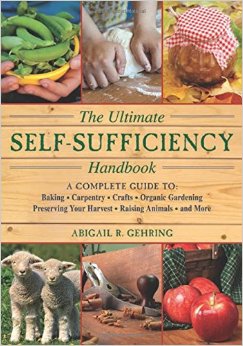
self sufficiency handbookSelf sufficiency is a topic near and dear to me. I don’t know why really but it has always been something that fascinated me…that and survivalism. I LOVE reading stories about families that live in octagonal houses in the middle of a nowhere, using solar power, growing their own food, and making all their home furnishings by hand. I am not quite sure if that life would be right for me but I can live vicariously right? This is why I can’t live without my Mother Earth News subscription.

I just finished reading The Self-Sufficiency Handbook – A Complete Guide to Greener Living by Alan and Gill Bridgwater who began their own self  sufficient life in the 1960s. Being self sufficient and living off the grid was once considered something pursued by “hairy hippies”. Now though, self sufficiency is trendy and cool. If you can unplug from the energy grid then you are envied. If you can feed your family all year with nary a trip to the grocery store you are model of frugality and practicality. To me self sufficiency means something very simple…it means being able to care for yourself and your family and this is an admirable goal. How many of us can say that we would be just peachy if tomorrow we didn’t have the option to run to Wal-Mart or Kroger? Could we grow our food if we had to? Could we make our own clothes? What would we do if we didn’t have garbage pickup? I think a great number of people in society today would be peeing in their pants if they suddenly had to take care of themselves.  Personally I like to pursue self sufficiency because I like to know that if I needed to…I could take care of my own. I imagine that doing so must bring a great sense of freedom.

The book starts off by addressing how you can choose the right plot of land for your self sufficient life. How much space you need, how to pick the right location, making sure you have access to water, etc. It is great information for those that are in the planning stages.

The next section addresses the self sufficient house which was of greater interest to me than the land part because I am pretty settled…for now anyway. ;) You can learn to be more self sufficient in the house or space you already have. Four different house types of varying degrees of self sufficiency were discussed at length. One of the houses had me chuckling a bit with solar powered, motorized drapes and an intercom system. I guess it just shows that self sufficiency doesn’t mean you have to give up creature comforts.

The book also addresses heating and cooking options, wood-burning stoves, lighting, water, toilets (loved the gray water flushing info), solar power, wind power, geothermal heating, recycling, and insulation. I have so many ideas for ways to increase my own self sufficiency in these areas it is exciting.

The second half of the book discusses feeding yourself with an organic garden….how much space you need, how to care for your soil, how to compost, how to rotate crops, how to control weeds, and how to grow just about every fruit and veggie common to your area. This book will be totally dog eared come spring. ;)

It also goes into raising animals for food or their byproducts…cows, sheep, goats, pigs, chickens, bees, etc. And going a step further it gives instructions for things like curing your own bacon, making butter, canning and preserving, making beer and cider, and making soap and candles. It is a very helpful book.

For anyone that wants a great intro into self sufficiency and how to incorporate bits and pieces of it into their existing life and home this is the book for you. If you want to go for broke and go completely off grid and be 100% self sufficient I would chase this book with a few others from my personal library:

The Encyclopedia of Country Living

The Self Sufficient Life and How to Live It by John Seymour

Just the Greatest Life by David Schafer

[tags]self sufficient, homestead, solar power, gardening, organic, hippie, off grid, farm[/tags]

Thursday, January 3rd, 2008

9 Comments

17
Dec

Illegal Discussion Part Five

This is part five of my discussion of Everything I Want to Do Is Illegal. illegal-cover.jpgRead part one here

Chapter 19 discusses Avian Influenza and chapter 20 talks about bioterrorism. They are closely related because they both work to taint our food and the USDA without fail will always try to claim that small family farmers are the ones propagating diseased food and/or are the ones most likely to be the source of a bioterrorism outbreak with their unsecured facilities.

Several years ago there was big scare about local chickens having the bird flu and Salatin shares some stories and theories. He even shares a widely held theory that the chicken industry “planted” the bird flu and accidentally let it get out of control. I buy that theory 100%. In fact I have a similar theory about almond growers and a salmonella outbreak. It was conventional almonds and not raw ones that were the source but somehow…miraculously raw almonds were the ones that got banned. Funny how things just work out like that for big agricorp? They get to stick it to their competitors when they should have been grabbing their ankles. ;)

Even when it is the large, industrial chicken farmers that are spreading disease it is the small family farmer that takes the heat. The USDA certainly won’t tell you Tyson did this to you….they want you to think that birds raised outside that can come into contact with air and other birds are the ones getting infected, when that could not be farther from the truth. They simply will not allow the media to portray their benefactors in a bad light. The local food chain is the fall guy.  I guess some people really are dense enough to believe that 100 chickens crammed into a small cage that eat manure and never see the light of day are safer to eat than a bird that gets fresh air, sunlight, and grass to eat.

Salatin goes on to compare small, local farms with that of industrial ones as far as access for bioterrorists goes. The USDA wants us to believe that industrial farms are immaculate, stainless steel wonder worlds that are guarded ferociously to protect all the wonderful people of this country. Small local farmers are dirty, careless, and certain to let any old terrorist on their property to taint food. Does this sound logical to you?

Industrial farms are almost devoid of people. Machines feed and water them, computers monitor temperature, and there is hardly anyone around. They are prime for terrorist infiltration. The actual processing facilities however, where they slaughter and process all that raw product is crawling with people, many of whom have no legal status to be in this country and do not even speak English. How hard would it be for a foreigner (because terrorists are always foreign don’t ya know) to get a job there and taint up to 10 tons of food? I don’t think it would be to hard….at all.

A smaller, local farmer would be much less likely to be targeted. It is also unlikely that they ever would be considered a viable target because they do not do the same volume and a terrorist will want maximum impact. The USDA is trying to make us fear the local food system when it would likely be the safest thing for us in the event of a bird flu outbreak or a bioterrorism event.

Chapter 21 addresses the NAIS or National Animal Identification System that the government wants to impose on us by 2011. Basically it would require microchips be implanted in all cows, pigs, chickens, horses, sheep, and goats. I think the program sounds crazy but supposedly it would make our food much safer if we tag all the animals. The fines you can rack up for stupid things, like forgetting to declare and animal dead or for having an extra chicken are outrageous. Also, the smaller farmers will have to tag each and every animal but industrial farms can have one tag per 10,000 animals. How fair is that??

Chapter 22 is about Mad Cow disease and how it became a problem. Also discussed is the disgusting practice of industrial farms to grind up animal remnants and manure (even from sick and diseased animals), mix it up with some grain and molasses, and feed it back to the living animals. It is practices like this that make mad cow disease possible but the USDA is not about to change things. They don’t really care about food safety.

If you recall a couple years back a company in Missouri called Creekstone Farms was upset because the mad cow scare in the US was causing foreign buyers to ban US meat products. Creekstone managed to secure a deal with a Japanese buyer that they could still do business if the farm tested every piece of meat they sold. Well, the USDA sued them! Why? The USDA said that if this farm tested every product then that would make all other meat processors who choose NOT to test look suspect in the consumer’s mind. So here the USDA is suing a company because that company is testing for mad cow disease. Creekstone eventually won that case but the USDA plans to appeal. If they really cared about food safety why would they sue companies testing for diseased meat?

Chapter 23 was not a favorite of mine. It talked of animal welfare and how farmer’s get vilified for buying chicks via mail order or using farrowing crates for sows. Salatin explains that when he orders 2000 chicks in the mail and the post office accidentally suffocates them or leaves them out in cold temperatures and they freeze to death this is the post office’s fault. Hence the farmer should not be vilified for a practice that would have been harmless to the chicks if not for careless post office workers. But I don’t buy that. The post office shouldn’t need to baby-sit your mail. If you elect to ship a living thing in the mail then deal with the backlash when it dies and people get mad.

The final chapter just sums thing up for us and tells us where we need to go from here. I particularly like this quote:

The political rationale for food safety ultimately rests in the notion that we are wards of the state. Not a free people.

I for one do not want the government telling me what I can and cannot eat. This is a basic freedom that I don’t think anyone should give up. The crack down on food is just getting worse everyday. Anything raw, even vegetables are getting the evil eye these days. Are we ready to throw ourselves under the bus of government protection because we are too stupid to know what is good for us? Are we ready to start eating sterilized, irradiated, processed, antibiotic laden “clean” foods for the rest of our lives?

Make your voice heard that this won’t be tolerated, find back door methods to get illegal foods such as raw dairy through cow share programs or donation based markets. Withhold your compliance from the tyrant that seeks to take our food freedom away…

[tags]Everything I Want to Do Is Illegal, book, review, Joel Salatin[/tags]

Monday, December 17th, 2007

1 Comment

7
Dec

Everything I Want to Do Is Illegal!

illegal-cover.jpgThe following book review, or discussion rather, has gotten long (think novella) so I will break it up into different posts. This is part one.

I was thrilled when I heard about Joel Salatin’s new book, Everything I Want to Do Is Illegal. I think I was foaming at the mouth at the thought of getting my hands on it and yes, it is everything I hoped for. It is an honest look at how our freedom to participate in traditional food growing and purchasing has been taken away. Every year the government tightens the noose and forces the American farmer to industrialize and centralize his or her operation and they force the consumers to purchase food products that fall within the realm of their total and complete control. We have little freedom to make our own food choices anymore and MANY people don’t even know it.

I first learned about Joel Salatin and his farm in Virginia called Polyface farms in Michael Pollan’s book Omnivore’s Dilemma (read my review). Pollan was prompted to write about Salatin when the latter refused to ship T-Bones steaks toNew York. It went against Salatin’s approach to an efficient food system which included eating locally. This got Pollan’s attention and he decided to visit Polyface farms and write many chapters about the farm and the farmer in his runaway best seller. The book launched Polyface into the spotlight as the epitome of the nations’ ecological farms.

Although the book did brush upon Salatin’s struggles against government agencies and beurocrats, Everything I Want to Do Is Illegal provides us with a detailed look and it is frankly quite shocking. It furthered my own unpopular opinion that the great old US of A is heading towards a closed democracy. Our food is one of the foundations of our culture and our freedom and it is assaulted daily by a government who feels we cannot possibly make healthy or responsible food choices without them. The irony is that the food deemed acceptable by government is really the LAST thing we should be eating. I touched on this in my post about why I think our government wants to make us and keep us sick.  If we value freedom and health we must do one very important thing…withhold our cooperation with the tyrannical and intrusive government food system. As mentioned in the Forward section of the book, Ghandi once said:

How can a few thousand Brits control millions unless we comply? We now propose to withhold compliance!

These words need to invigorate us to fight for our freedoms that are being taken away even as we speak. This issue is just too important to ignore and reading this book will help you to understand that. Everything I Want to Do Is Illegal I is quite simply one of the most important books I have ever read.

The introduction contains an essay by Salatin that he published in Acres USA. The essay had the same title as the book and he came upon the title when he was invited toLondon to participate in a panel discussion about the pressing needs of a heritage based food system. One by one participants at the 30 person table highlighted what they perceived to be the biggest impediment facing our food system. Some talked about the trafficking of cheap organic food, another mention labor issues, and so on. When it came time for Salatin to speak he blurted out “Everything I want to do is illegal!” It is funny how such a simple sentence sums it up.

Read part two of this book discussion.

[tags]Everything I Want to Do Is Illegal, book, review, Joel Salatin, Michael Pollan, Omnivore’s Dilemma[/tags]

Friday, December 7th, 2007

8 Comments