I have written extensively about BPA or Bisphenol A on this blog. It is a
hormone mimicking chemical that can be found in some plastic types. It is most commonly found in baby bottles, water bottles, kids feeding items (cups, plates, bowls, utensils) toys, etc.
Today I saw an investigative journalism report from Fast Company that takes the BPA issue and really tells it like it. They accuse plastics manufacturers and chemical companies that make BPA of using the same tactics used by Big Tobacco to fund fraudulent studies and sow seeds of doubt about their dangerous product.
They did their own in depth investigation and found that the BPA debate is nothing but “a battle to protect a multibillion-dollar market from regulation”. This quote was especially telling:
Just five companies make BPA in the United States: Bayer, Dow, Hexion Specialty Chemicals, SABIC Innovative Plastics (formerly GE Plastics), and Sunoco. Together, they bring in more than $6 billion a year from the compound.
Of the more than 100 independently funded experiments on BPA, about 90% have found evidence of adverse health effects at levels similar to human exposure. On the other hand, every single industry-funded study ever conducted — 14 in all — has found no such effects.
It is a long article but worth the read with shocking info about scientists requesting that their names be removed from reports that claimed BPA was safe and final report statements about BPA being safe being made BEFORE studies even started!
The government is unlikely to start controlling the use of BPA. The United States has a long tradition of keeping harmful substances — lead, DDT, tobacco, PCBs — on the market for decades after scientists find adverse effects.
This is why consumers need to educate themselves about BPA and let their money do the talking. We can vote against BPA ourselves by not buying products that have it and supporting companies that don’t use it. Here are some of my BPA articles with product links:
BPA Free Sippy Cups – Foogo, Klean Kanteen, Sigg, Avent Naturally, and Born Free
BPA Free Sippy Cups Part Two- Boon Fluid, The Safe Sippy, Nuby, ThinkBaby, and Funtainer
BPA Free Water Bottles
Glass Baby Bottles- Evenflo, Medela, Playtex, Born Free
BPA Free Baby Bottles Part Two- Glass bottles with protective sleeves (Siliskin and Wee-Go), and polycarbonate plastic baby bottles, Green to Grow, Nuby, Dr. Brown, Evenflo, Adiri
BPA Free Teethers and Pacifiers- Sophie, Natursutten, Raz-Berry, Playtex, Gerber, Chan Pie Gnon, Nuby, Sassy, and more.
BPA Free Plates, Cips, Bowls, and Utensils- Boon, Camden Rose, Mini-Me, Emily Green, Dombo, Trebimbi, Sassy and more.
BPA Free Lunchboxes, Nursing Gear, and Toothbrushes
BPA Free Popsicle Molds
BPA Free Blender
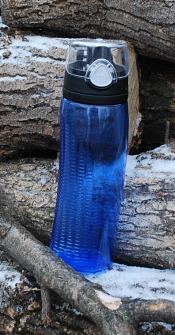
I have always had a favorite water bottle and his name is Mr. Klean Kanteen. But step aside Klean because you may have been replaced. Okay maybe not replaced, but you will now have to share your coveted position in my cupboard. Make room for the sleek and ingenious Intak by Thermos.
I wondered how I would like the Intak but I can now say I am a huge fan and while the Intak is a reusable (green) water bottle it does have a big strike against it…it is plastic. BPA free, safe plastic but plastic none the less. But am an ardent admirer now and I will tell you why.
The Intak is a great sports bottle…emphasis on sports, activity, hiking backpacking, camping, etc. In that respect the Intak wipes the floor with heavier stainless steel bottles. I personally do not like to take Klean Kanteens on hikes or when camping because it is heavy and when backpacking or day hiking weight is extremely important. Backpackers know the full weight of their packs down to the ounce…just look at backpacking gear in a sporting goods store and look to see how they put the weight on everything. Sigg is not as heavy but it also has another problem that it shares with KK. They are cold. If I put a cold liquid in either of these bottles, the temp transfers to the outside and it can be very uncomfortable to hold onto such a cold bottle, especially in winter. An insulated bottle somewhat fixes this but it adds weight. This problem is not as pronounced with plastic.
Also, when backpacking or camping I sleep with my water bottle in cold weather to keep it from freezing. I know I don’t want to sleep next to a cold metal bottle. ;)
Beyond that, the Intak has an ingenious design…the best I have seen. The bottle portion is long and sleek with ridges along one side to help with grip. It has an ounce measuring line on the other side so you can keep track of how much you are drinking. This leads to another reason why plastic as opposed to stainless steel makes a better sports bottle…you can see the water levels. Knowing how much water you have is important when backpacking or camping.
The Intak has a push button on the cap and with one push the top pops open so you can grab the bottle, pop the top, and drink all with one hand! To prevent you from accidentally opening it you can put a little metal flap over the button to keep it from engaging….perfect.
AND it also has a sturdy plastic loop on the back of it so you can attach it to a pack or belt if you want to. This is a great feature. It even rated a mention by The New York Times as a great bottle for sports enthusiasts.
It is made of plastic that is BPA free so you don’t have to worry about toxic leaching into your water. You can also put in on the top rack of the dishwasher.
It comes in blue and purple, green, and pink. If you are a die hard stainless steel fan they even have a SS version!! I have the blue one as you can see above and below. If you are in the market for a reusable bottle this is a good one! The $11.00 price tab is great too.
Update: 7/31/2011 – Still using this bottle and it is the one that I reach for quite often! When we went hiking in the Hocking hills region of Ohio just today I grabbed this lightweight bottle without hesitation and it was cinch to carry all day long.

Yet another great family owned store giveaway! The Soft Landing is a store dedicated to healthy, non-toxic
products for the whole family. With all of the conventionally available products, and especially feeding items that are made of toxic plastics, Alicia Voorhies (a former RN) decided to give parents a better alternative. You will not find products with Bisphenol-a (BPA), phthalates, and PVC. What you will find are safe baby bottles, teethers, sippy cups, feeding gear, water bottles, lunchboxes, and much more. The site is also a great resource for finding out exactly why some plastics are dangerous with all the latest research and news about the topic.
What I love the MOST about this store is that they have amazing sampler packages where you try different brands. You don’t have to buy a six pack of one brand and then find out you don’t like them, you can buy several different products in one package and then see what works and what doesn’t. This feature is a huge time and money saver for parents.
If you want to stay up to date on the latest “safe” products and research into the not-so-safe ones, I suggest you sign up for the Soft Landing newsletter on left side of their web site. And now on to the giveaway! Alicia and her team at The Soft Landing have been gracious enough to giveaway an awesome prize pack to my readers and it is just in time for cold weather! Imagine drinking your coffee and tea in
safety and style with these gorgeous Thermos containers. A $67 dollar value!! Great for you or for Christams gifts. ;)
The Thermos Stainless Steel Coffee and Tea Prize Pack:
1 – SS 12oz Tea Tumbler w/ Infuser – Espresso $23.00
1 – SS 18oz Grande Coffee Tumbler – Espresso $26.00
1 – SS 16oz Coffee Tumbler – Metallic Blue $18.00
The winner is comment #52 Princess Momma!!!
This is a new feature I have added to organize reader questions. Some days I spend quite a bit of time writing out answers to questions that readers send only to have someone ask the same question 2-3 months later and I can’t find what I previously wrote. Well, it was about time I smarten up here…I will be answering them on the blog so I can just send a link…easy peasy.
Q: I think you may be past the point of needing infant formula, but do you have any strong feelings towards any of them? I need to supplement my 6mth old b/c I’m just not producing enough to keep her tummy from growling =(. We started Nestle- but then I read on various websites criticism towards the company for undermining breastfeeders. Now with contamination in formula from China and BPA in cans – I’m not sure what to use. I find it difficult to trust these companies.
A: Well, I am past the point of formula feeding but I DID use formula in the not to distant past as I had to stop breastfeeding my youngest at 6 months when I was diagnosed with cancer. It was an agonizing thing for me because I know breast is best but I know personally that there is sometimes a need for baby formula and the BPA in the linings and now the Melamine in formula from China is pretty scary.
First off I would stay away from soy. There are numerous reasons why processed soy is not a good idea…especially for infants. The BPA issue is present with all forms of baby formula. The Environmental Working Group found that “Every manufacturer except Nestlé said it uses a BPA-based lining on the metal portions of their powdered formula cans. Nestlé failed to provide EWG with reliable documentation of their alternative packaging, and thus is not a clear improvement over other types.” Also “Powdered formulas are a better choice. Our calculations indicate that babies fed reconstituted powdered formula likely receive 8 to 20 times less BPA than those fed liquid formula from a metal can.” So if you have to choose between powdered or liquid…go with powdered.
I personally used Nature’s One Organic Baby Formula for my son. They state that their formula cans are BPA free but that there MAY be trace amounts of BPA on the metal pull-back lid. They are also USDA certified organic, which I like. And this is a USA made product…no ingredients are sourced from China.
There is also the issue of how additives like DHA and ARA (omega fatty acids) are added. Most companies use chemicals like hexane, acid and bleach to extract these components. The only one I have found thus far that claims they do not use this process is Nature’s One. But other companies say that any other method is not FDA approved so who do you believe….sometimes it sucks to be a consumer.
My suggestion for anyone though would be to call the maufacturing company and ask them directly about any of your concerns. Another to look into would be Earth’s Best Organic Formula. And if it is in any way possible to breastfeed…do it…then you don’t have to worry about any of this.
Other links: Make Your Own Baby Formula & Use Donor Breastmilk
*******
Q: I’ve read that you cloth diapered and I recently started. I have been a bit disappointed just because I have had a hard time finding what I want to use. I have gone with fitteds with a wool cover because I wanted to avoid all plastic. Unfortunately my favorite diaper is bumgenius 3.0 because it is so much easier and less bulky. But it irritates me that it’s my fave because of the pul outer. I am very skeptical of using polyurethane laminate on a baby. What do you think of PUL? I’ve had a very hard time coming up with any real evidance on this. My problem is everyone criticizes disposables for the plastic, organic bedding companies rant against polyurethane foam, and polyethelane is supposed to be the safer of plastics… so why is everyone using PUL?
A: GREAT question! Cloth diapers have two major options…a cloth diaper that needs a waterproof cover or a diaper that already has a waterproof layer (AIOs, pockets, one-size). MOST cloth diapers will use some sort of plastic in the cover or waterproof layer….it could be a vinyl material, nylon, or it could be a polyurethane laminate (PUL) which is basically laminated polyester. Well, obviously we see the inherent danger in using vinyl (I hope), but what about PUL? Well, polyester is not a natural material, it is synthetic and the laminate is plastic. Furthermore, “polyester slowly emits phytoestrogens, which are endocrine disruptors, or compounds similar to estrogen, which can promote certain types of cancer.” * Being a long time member of the cloth diapering mom community I have also heard my fair share of stories about PUL causing bad rashes and skin reactions.
So if you want truly natural materials you may not want to use these diaper types and they are the most popular ones…the BumGenius 3.0, Fuzzi Bunz, etc. I have used many of these in my diapering lifetime but eventually opted to use cotton fitted diapers and wool covers and longies. Wool is naturally waterproof so if you are concerned I say go the cotton/wool route. When in doubt…go with natural fibers.
Check out these Swaddlebees Merino Wool Diaper Covers and these Ecobaby Absorb-it-all 100% Organic Cloth Diapers.
Keep the questions coming!
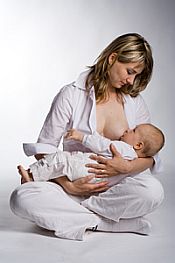
World Breastfeeding Week is coming in August. The goal is too bring awareness to breastfeeding which in actuality seems kinda silly to me. Moms have two feeding implements on their chest at all times and we have to have a national awareness week to make them aware of what they are for?? Hmmm. With the advent of baby bottles and formula feeding it seems breastfeeding has taken a back seat but there are probably hundreds of reasons why it should get the attention it deserves. I truly believe that formula feeding will never – EVER come close to being as good for babies as good old fashioned breast milk. It is nature’s perfect baby food and no BPA in the food like with formula cans. Breastfeeding is the easiest, least expensive, and greenest option for you and your baby.
Think about all the waste generated with the manufacturing and use of millions of baby bottles, millions of cans/bottles of formula, drop in liners, nipples, detergent and water used to wash bottles daily. The practice of bottle/formula feeding is amounting to millions of tons of waste each year.
Beyond all the health benefits…and the green benefits…I found breastfeeding to be the most deliciously wonderful bonding experience imaginable. Breastfeeding didn’t work out so great for my first baby. I let the hospital talk me into supplemental feeding when my milk didn’t let down until 3 days after birth. They sent me home with 3 cases of formula and because I didn’t want them to go to waste….I ended up only breastfeeding 50% of the time and then I quit altogether at 4 months. Coincidence that my first baby was very unhealthy, got Epstein Barr, and had a terrible vaccine reaction…I don’t think so.
My second baby was breastfed until she was two years old with 6 months of that spent nursing her baby brother too and I would have continued nursing both of them in tandem as long as they wanted but cancer kinda ruined it. It wasn’t always easy being the sole feeder of my kids, or nursing while pregnant, or nursing two kids, but it was worth it. Happy times :)
But in acknowledgment of how it not always easy to stick with breastfeeding I have collected some tips:
1) A natural and unmedicated birth is the best start to a breastfeeding relationship. Both mom and baby are more alert and responsive and can start their journey under the best possible circumstances.
2) Alert hospital staff in writing and verbally that you are going to be breastfeeding and that you do not want bottles or pacifiers to be given to your baby…no artificial nipples, as this can create confusion and frustration.
3) Find doctors who support breastfeeding and won’t recommend weaning to formula at the first sign of difficulty. You need doctors who will help you make breastfeeding work for as long as it takes.
4) Babies nurse for a wide variety of reasons, and some of them have little to do with hunger. Nursing frequently ensures you will have a healthy and steady milk supply to meet your baby’s needs. It is also a source of soothing and comfort for baby.
5) Get comfortable nursing in public. If you start to feel like a caged animal that can never leave the house because breastfeeding needs to stay behind closed doors you might get frustrated fast. The general public needs to learn acceptance of this natural practice anyway. Practice in front of a mirror so you can learn to do so discreetly. Nursing covers are also very helpful.
6) Get the latch right. A proper latch onto the breast is one of the most, if not THE most important thing you can do to avoid pain and ensure adequate draining of the breast (which leads to an abundant milk
supply). Get help if you and your baby are having trouble or if breastfeeding is causing you pain.
7) Cosleep! Bringing baby into your bed makes breastfeeding so much easier. Everyone generally gets more sleep because 2:00 am and 4:00 am feedings can be handled by just rolling over and making your breast accessible. It just can’t get any easier to handle night time feeding.
Check out my review of a wonderful breastfeeding book called Mama’s Knows Breast.