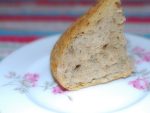
I have long been a fan of sourdough. I have always loved the taste (Cracker Barrel whole wheat sourdough toast anyone?) but I falsely assumed that the delicious taste meant it was bad for me. Well, over the years my knowledge and ideas about diet have really come a long way. At the moment I am a nourishing foods vegetarian, who eats high raw and cultured/fermented foods whenever possible. While I don’t generally eat meat I will on rare occasions if it is local and pastured. I certainly have reasons for eating this way (backed up by years of research) but I eat this way mostly because it is what I “feel good” eating. As someone with digestion and gut issues, as well as a stint with colon cancer, that cannot be undervalued. That is why I don’t draw hard and fast rules… because what feels good can evolve.
Part of that evolution has been the knowledge that grains in general are not that good for us. This is a big part of why so many people love the Primal/Paleo diet. Here are some of the more widely known issues with grains:
* They are hard to digest
*They often have nutritional deficiencies due to the refining process
*The more grains we consume the more likely it is that other more nutrient dense foods are displaced
*They are low in healthy fats
*Antinutrients designed to preserve and protect the grains in plant form stop us from absorbing nutrients and can cause allergic reactions and sensitivities.
*Cereal grains are known to be causative in some autoimmune disorders like Celiac disease.
* Phytic acid in grains, nuts, seeds and legumes causes dental decay.
It is due to the antinutrients (like Phytic acid) that soaking grains, nuts, beans, and seeds is so important. Soaking deactivates them and makes the food more digestible and usable by our bodies. It is no wonder that so many people have problems with vegetarian and vegan diets because often times they are eating WAY to many grains and they are not soaking them first. Thus they cannot access the nutrients in a large portion of their diet AND what they are eating may actually be chelating important metals like iron and zinc. They are quite simply doing it all wrong.
So… why did I mention sourdough at the beginning of this post? It is made from grains no? Well in much the same way that we ferment milk and turn it into yogurt or kefir (and thus much more digestible and healthy) we can ferment grains as well and make sourdough. Sourdough is a dough containing a lactobacillus culture, usually in symbiotic combination with wild yeasts. They are wild because you make sourdough starter by leaving it out on the counter for 4-5 days in order for airborne yeasts to “sour” it. This fermentation process neutralizes the antinutrients that we want to avoid. Any sourdough item begins with the starter and then it is allowed to sit, rise and ferment the rest of the dough so that the batch can ferment.
I don’t eat a whole lot of grains anymore but what we do eat we try to ferment first. Oh and you can soak whole grains, like wheat berries, rice, millet, and quinoa, too. You soak them by placing them in water for 12 to 24 hours with 1-2 tablespoons of whey, vinegar, buttermilk, yogurt, or kefir and then rinsing them off afterwards. The acid helps to neutralize the antinutrients. But I digress… sourdough. You can actually make much more than just sourdough bread. In fact we rarely make loaves of sourdough bread. Instead we make sourdough pancakes, sourdough pizza, sourdough waffles, sourdough english muffins, sourdough crackers, or even sourdough tortillas. You are upping the health factor of all these grains by fermenting them first. Oh and they taste REALLY good.
I keep my sourdough starter or “mother” in Ball jar on the kitchen counter (next to the Kefir) and the lid is loose fitting to allow air in. Another gal I know puts hers in a crockpot on the counter and she covers it with a towel. Some just pinch off a ball of dough from whatever they are baking and freeze to incorporate into their next baking project. I feed it every day pretty much and bake with it a couple times a week. If I do not plan on baking I will stick it in the fridge for a few days until I am ready to use it. We use local whole wheat flour in many of our recipes, sometimes all wheat and sometimes a mixture of wheat and white whole wheat. The kids generally appreciate a half/half mixture. Sourdough is really only as good as the flour you use.
One of the BEST resources I have found for getting started with sourdough and trying new sourdough recipes is the GNOWFGLINS sourdough e-course. The basic membership is $10 a month and I cannot recommend it enough. It walks you through making your own starter with PDFs and video and it also walks you through dozens of recipes, with more added each week. How easy can it get when you can take a seat in someone’s kitchen, virtually of course, and watch them make each recipe?
In addition to some of the recipes I mentioned above there are MANY more… sourdough donuts, sourdough gingerbread, sourdough cake, sourdough crepes, and sourdough pasta to name just a few. A membership also gives you access to their other course on Food Fundamentals and I believe for future courses too. They have a cheese course planned that I won’t miss. I get am getting no incentives for recommending them I am just a member myself and a very pleased one at that.
My husband saw me watching the videos and he is now on a sourdough kick himself. We are not eating any more grains than we ideally want to, we are just making sure that the quality is top notch in what we do eat. This week I hope to make sourdough pasta and pair that with mushrooms, spinach, and a creamy mustard sauce. It is a dish we love to eat once a month or so and I hope it is improved by the sourdough. I also recommend Classic Sourdoughs: A Home Baker’s Handbook.
So do you sourdough yet?
Thursday, December 2nd, 2010


Welcome! Here you will find the random thoughts and experiences of a mom trying to live a more natural and green family life since 2004. Enjoy! Feel free to